
Reactive Systems are Overwhelmed Systems: A Comparison of Logic
Why we must stop treating homelessness as a sudden emergency and start moving upstream.

The last few weeks, we have sat with the discomfort of missed opportunities—those specific, identifiable moments where a different structural choice or a more connected system could have fundamentally altered a young person’s life trajectory.
It is a heavy reflection. But if we refuse to look closely at precisely where our current systems miss the mark, we cannot design a framework that works.
To move beyond the rhetoric of “fixing the system,” we must first define the architectural difference between the system we have and the system we need.
We must contrast the operational logic of crisis management against the architecture of true prevention.
The Anatomy of Two Systems
When we look at how social policy treats vulnerability, we are essentially looking at two competing philosophies of timing, data, and intervention.
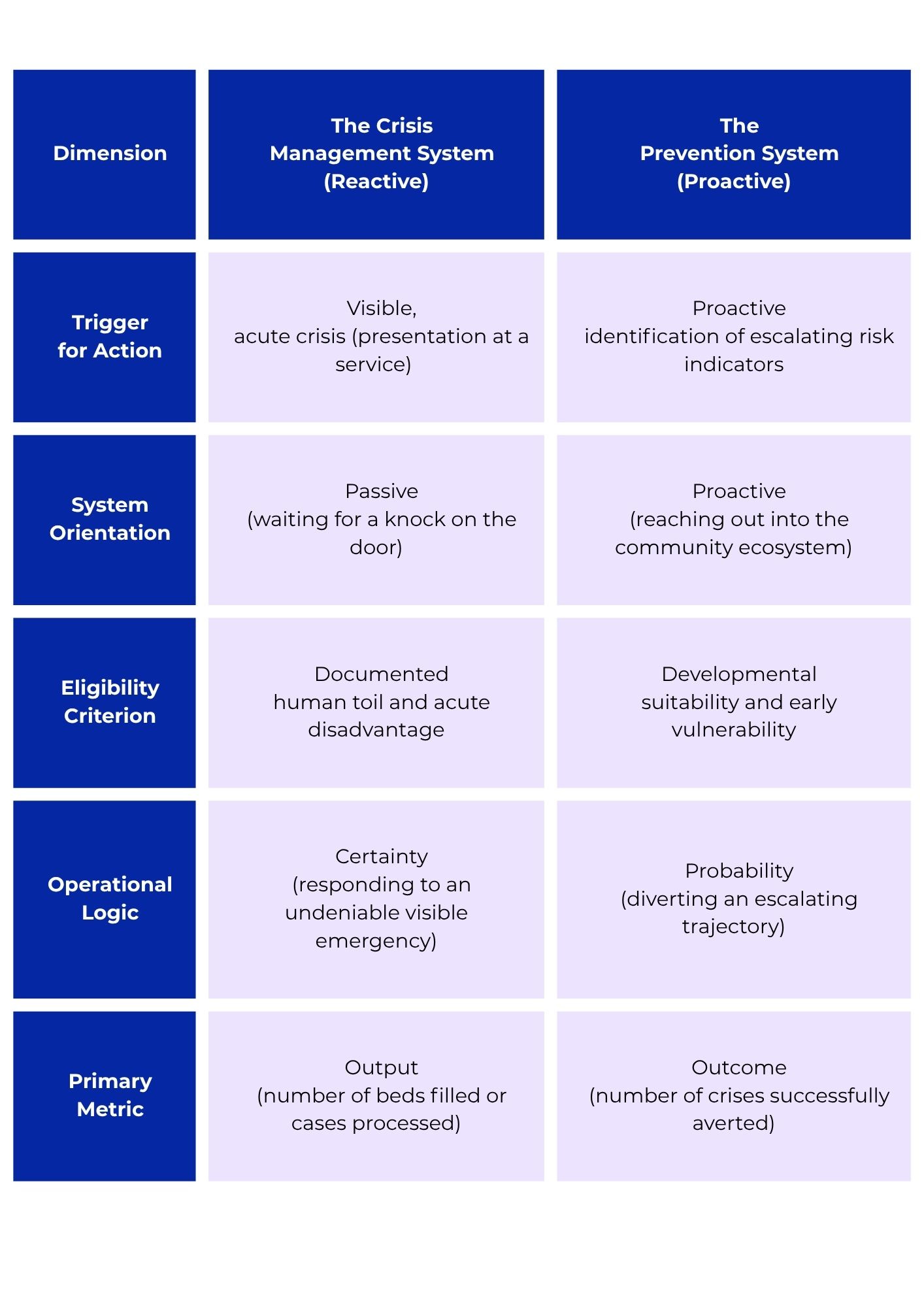
The Illusion of Responsiveness
The reactive, crisis-driven model is incredibly seductive because it creates what we might call the illusion of responsiveness.
When an emergency accommodation service is full, or an emergency department is bustling, the system looks highly responsive. It is busy. Resources are being deployed, frontline staff are working tirelessly, and the public can visibly see where the funding is going.
But we must not confuse activity with effectiveness.
A busy system is often an overwhelmed system—one that is trapped in a feedback loop of its own making. By waiting for vulnerability to graduate into a public crisis before it triggers a response, the reactive system ensures that its caseload will always be acute, expensive, and deeply entrenched.
It treats homelessness, disengagement, and severe distress as sudden, unpredictable events. But they are rarely sudden. They are the predictable, lagging indicators of a long cascade of missed signals.
Flipping the Architecture
True prevention—working upstream—requires an entirely different operational logic. It shifts the focus from managing the downstream damage to changing the timing of the intervention itself.
Where a reactive system asks, “Is this person homeless enough or unwell enough to qualify for a response?” an upstream system asks, “What structural supports can we wrap around this environment to ensure this trajectory disrupted?”
This is why we must strongly advocate for community-integrated frameworks rather than isolated, siloed, programs. Prevention cannot simply be an emergency response executed slightly faster; it must be a structural bridge built directly into the places where young people already live their lives—their schools, their communities, and with their family and natural support networks.
The True Measure of Success
A hard part of shifting from a reactive model to a proactive prevention architecture is a cultural one: we have to learn to value the invisible.
In a crisis-driven system, success is visible. It is the rescue and the emergency intervention.
In an upstream system, our greatest successes are the ones that never make the news. It is the family relationship that didn’t fracture. It is the school exclusion that didn’t happen. It is the young person who quietly stayed on a stable path because the system intercepted the risk before it became a crisis.
Until our funding models and policy frameworks move past the “Wait and See” logic of crisis management, we will continue to spend vast resources on our deepest failures.
It is time to change the timing. It is time to work upstream.